





The Chinatown Heritage Centre in Singapore is a hidden gem. While roaming around in Chinatown, I accidentally came across the building. While stepping into the building, I had no idea I would spend the next 2 hours there! How is this not recognized as one of the top attractions in Singapore? The history of Chinese immigrants and the fantastic transformation of Chinatown is laid out here through photographs and artifacts.
Visitor Information:
Address: 48 Pagoda Street, Singapore
Open Hours: 9 A.M - 8 P.M everyday
Entrance Fee: $8 for adults, $4 for children
Phone: +65 6325 2878
There was a great diversity of migrants who made their way to Singapore from the early 1800s. The Chinese formed the bulk of immigrants to Singapore. They came from different provinces and districts. Among them were actors, craftsmen, traders and scholars. Others were laborers, farmers, servants and youngsters who came with no particular skills except a willingness to work and a hope for a better life. Let us look at the history of Chinatown in chronological order:
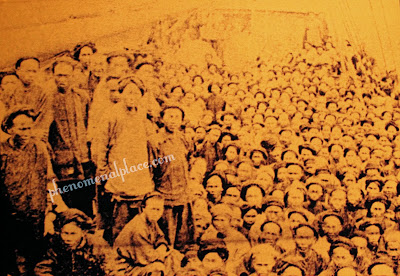 |
| Chinese immigrants packed into the basement of a junk boat |
Mad Rush To Singapore:
In China, people lived in terrible poverty. The heavens plagued them with floods and famines. Their rulers were corrupt, war took away their sons and foreigners invaded their coasts. Desperate, they turned to Nanyang - a place where there was work to be had and food to eat. With fresh hope, they took the dangerous sea journey to Singapore. It was common practice to pack immigrants like sardines in a junk boat and those who died on the way, had their bodies thrown into the sea."It was a seven-day journey from Hong Kong to Singapore and cost HK$20. On the way, some of the children got sick, died and were thrown overboard by the deckhands. As we sailed into the harbor in the evening, we could see the street lamps and the bright red flag raised on a hill. I was only 19 years old."
- Loh Ah Kwai
Samsui Woman
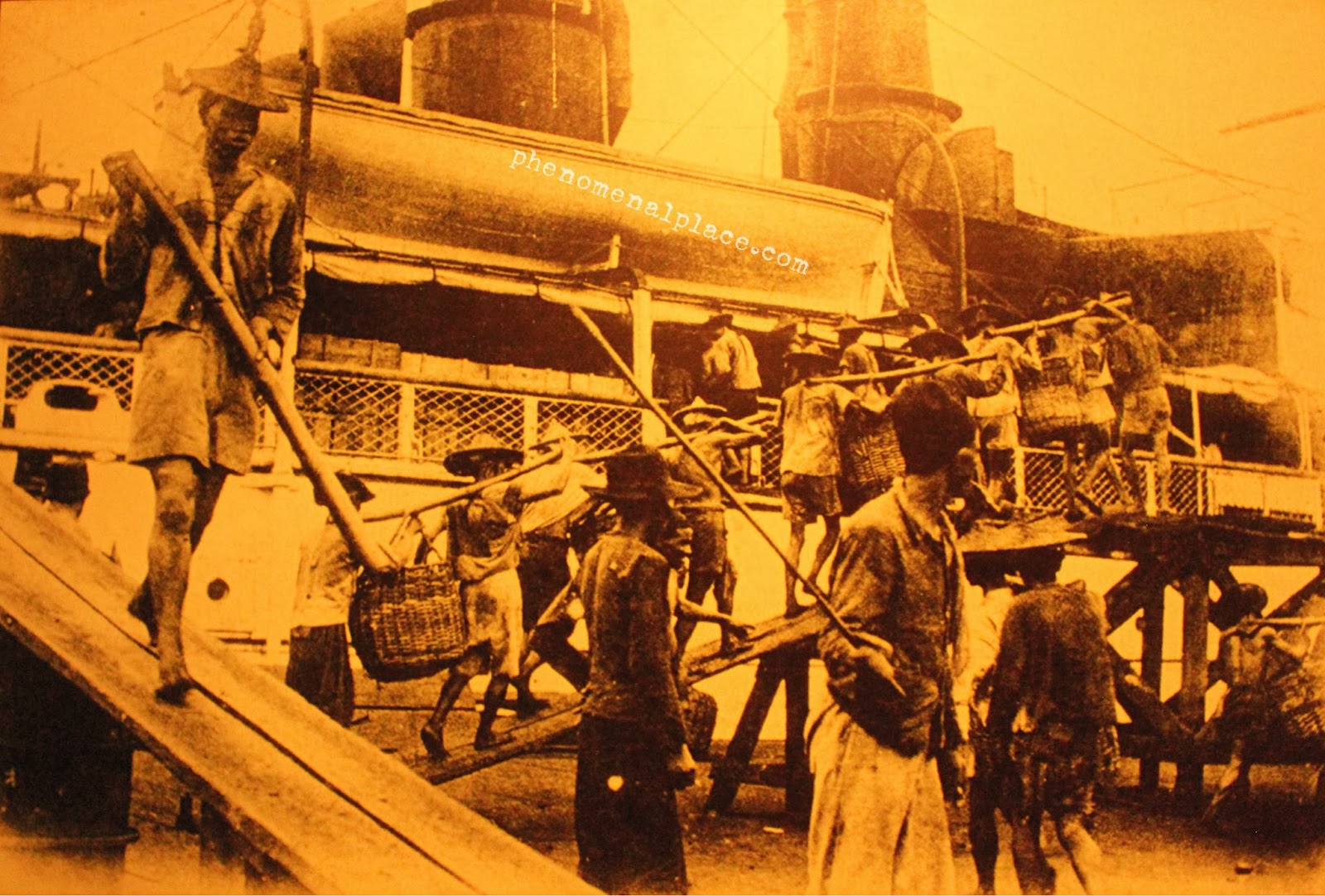 |
| Reaching Singapore meant work, food and fortune |
- Leong Ah Hoe
Majie (Domestic Servant)
Upon Arrival To Singapore:
"When we arrived, we were sent to the Chinese protectorate. The official asked us, 'Why did you come to Singapore?' I said 'I came to Singapore to earn money and feed my father. My father could not work anymore because he is old'. He said 'Many people were abducted.' I said 'No, I was not. I came here voluntarily to work'. So he let me off."- Leong Ah Hoe
Majie (Domestic Servant)
 |
| Chinese coolies eating lunch on the street
"On the way to Singapore, I was seasick for one whole day. I could not eat and I vomited all the time. Upon arrival, I saw many workers carrying loads of coal, their bodies all covered with black soot. At that very moment, I realized that life was going to be difficult here"
- Ng Teow Yhee
Businessman, Stevedoring
|
Grateful survivors of the dangerous journey to Singapore gave thanks at temples like the Wak Hai Cheng Bio . Here, they would worship their Gods and ask for good fortune and protection from evil.
 |
| Immigrants who arrived to Singapore safely, pray at Wak Hai Cheng Bio temple |
 |
| Thian Hock Keng Temple was also popular among Chinese immigrants |
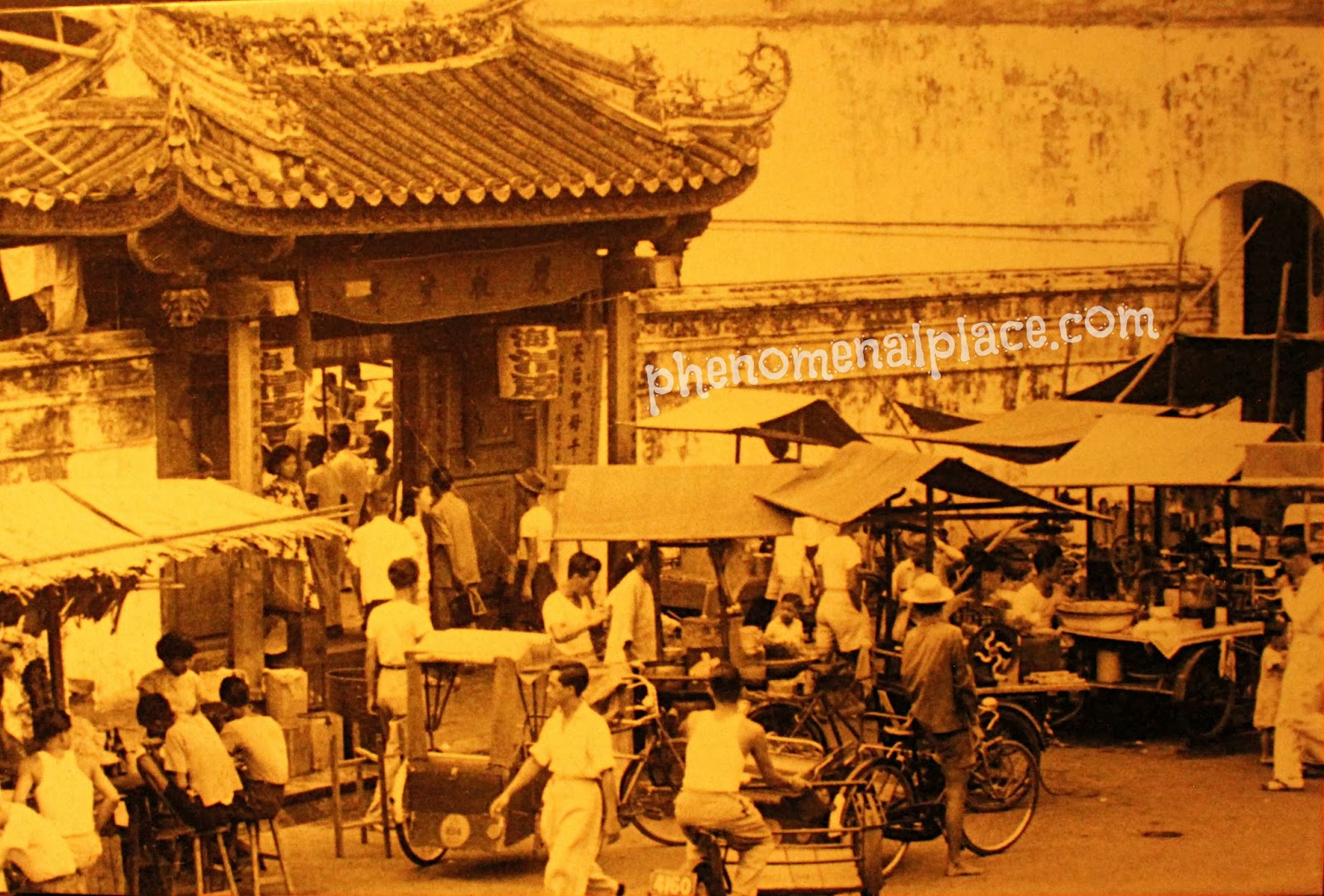 |
| Bustling street activities at front entrance to Wak Hai Cheng Bio Temple |
Chinatown - a place called Bullock Cart Water. Here the Sinkhehs or new migrants had their first experience of so many dialects being spoken, and their first glimpse of the many races: Indians, Malays, Arabs, Europeans and Jews. Bonded workers were hurried off to their temporary quarters, while the others tried to find their way to the homes of their relatives. In this hot, strange land, they began their new lives.
 |
| A Chinese boy learns to carry water, while Indian Tamils help him
The Chinese immigrants found jobs on the South Bridge Road. Carrying water to other parts of the city, was popular and profitable. They made friends with Tamils from India, who did the same job as well. Malays, Indians and Chinese would all work together, eat lunch under shady trees and become good buddies.
|
 |
| Indians and Chinese working together at South Bridge Road junction |
- Sng Choon Yee
Interpreter
 |
| South Bridge Road, with bustling bullock carts |
Success Is Not Easy:
When Colonel William Farquhar was Resident of Singapore from 1819 to 1823, opium, liquor and gambling licences were sold to obtain revenue for running the island. This move was a death blow to many immigrants. Away from their homes and families, the Sinkhehs lived only on hard work and memories. Many had to come alone, without the warmth and affections of their loved ones. Young and impressionable, they found solace in the evils associated with the secret societies: prostitution, opium smoking, drinking and gambling.
 |
| When opium did not kill people, it killed their dreams |
What motivated a young immigrant to gamble? Perhaps it was the route to easy, fast money where many thought they could win and return to China with money in their pockets. But sadly, most would lose their hard-earned cash and had to remain in Singapore.
 |
| Youngsters played the Chinese Fan-Tan game which robbed their hard earned money |
"Grandma was determined to stay with grandpa to rescue him. She stayed in the opium den with him, cooked for him, nursed him and prevented him from touching the thing. It was really tough at first. But after a few weeks, he started to lose interest in opium. When he gave up the thing, life began anew for him, and of course, for them too."
- Xiao Huiling
Schoolgirl
Pasir Panjang School
 |
| Opium - One hit was too many, and a thousand was not enough |
 |
| Wealthy youngsters enjoying opium in an opulent bar |
- Woo Choy Yin
Printing Firm Worker
Occupant of 46 Pagoda Street
Prostitution & Drinking:
Cabaret and brothels were open all night long, where people drank and lost all their earnings.
 |
| On the top floor of this building was a famous Cabaret house |
- Chee Yoke Weng
Grocer's Assistant
The Land Of Opportunity:
For people who did not fall into bad habits, Singapore was a symbol of hope and success. However, their fortune would come only after hard work and perseverance. People started building their own businesses and many of them would succeed.
 |
| A busy Chinese restaurant, run by a hard working immigrant |
- Chew Choo Keng
Founder
Khong Guan Biscuits
Poor, young and illiterate when he arrived in Singapore in 1934, Chew overcame all these obstacles to become the largest manufacturer of biscuits in Singapore. Today, Khong Guan Biscuits exports around the world.
 |
| Shops like these were opened with hard earned savings |
going home altogether."
- Loh Ah Kwai
Samsui Woman
Chinese Opera & Theaters:
When people started becoming successful, there was more money available to spend on cultural activities and entertainment. The immigrants patronized Chinese opera, which was initially staged in front of temples during religious festivals. In Singapore, Chinese opera has the unique Malay name of Wayang.
When people started becoming successful, there was more money available to spend on cultural activities and entertainment. The immigrants patronized Chinese opera, which was initially staged in front of temples during religious festivals. In Singapore, Chinese opera has the unique Malay name of Wayang.
 |
| Oriental theatre, was a popular place for Chinese opera
As business flourished, Wayang was elevated from cheap street entertainment to a thriving business. By 1881, there were about 240 Chinese performing artistes residing in Singapore. The Chinese opera was performed on several theaters like the Majestic and the Oriental, which attracted a large audience.
|
 |
| Majestic theater - Another famous place to watch Wayang (Chinese opera) |
Japanese Occupation:
In 1942 Japanese forces invaded Singapore and killed thousands of Allied soldiers (RIP at Kranji War Memorial.) They gained complete control of Singapore, which upset the economy of the country. The economic downturn and subsequent loss of jobs caused thousands to turn to hawking on the streets and in the markets. After the Japanese Occupation, Chinatown continued to flourish in peacetime. In the 1950s, it entered into what was known as "The Golden Age of Chinatown" - the liveliest and most bustling period of Chinatown's history.
In 1942 Japanese forces invaded Singapore and killed thousands of Allied soldiers (RIP at Kranji War Memorial.) They gained complete control of Singapore, which upset the economy of the country. The economic downturn and subsequent loss of jobs caused thousands to turn to hawking on the streets and in the markets. After the Japanese Occupation, Chinatown continued to flourish in peacetime. In the 1950s, it entered into what was known as "The Golden Age of Chinatown" - the liveliest and most bustling period of Chinatown's history.
Bit by bit, lives got better. Most Chinese immigrants became successful due to their hard work and led a happy life in Singapore. It had become their home, their own country. Many established their own businesses, got married and bought houses. Festival times were used as vital tools when they could relax, meet family and friends and remember their Chinese traditions.
 |
| Children playing with firecrackers, 1971 |
 |
| The Chinese New Year market used to open about 2 to 3 weeks before the event |
"We, Tung Kun people, had a custom on the first day of New Year called 'Mai Lau' (selling laziness). How did you sell it? On the first day we would bring out a duck egg and cook it. Then we would stick a joss stick in the egg and bring it out into the streets yelling 'Mai Lau! Mai Lau'. When someone laughed, we would throw the joss stick at him and our laziness."
 |
| An old New Year Greeting Card |
I hope you enjoyed the history of Chinatown, and it gave you a new perspective on the history of Singapore. It was very enjoyable to look at old photographs, and there are a few hundred more which I can't post here. There are also hundreds of props and objects like old bicycles, magazines, ceramics, etc at the Chinatown Heritage Center. If you are a Singaporean, whether you are Chinese, Indian or Malay, visit this museum when you get a chance. If you are a tourist, please step into this building while you are in Chinatown. It is one of the must see attractions in Singapore.


7 comments:
thanks for the history singapore chines connections,china town, little India.there is no.of arcieve photos, and about opium which is very valuable informations thanks posting.
Thank you, Chinese history in Singapore is really interesting. Wish I spent more in the Chinatown heritage centre.
I wish I knew about this before I went there.
Hi,
May I know if you have the original photos of the Wak hai Cheng Bio Temple? My company is doing a documentary about Singapore's evolving architecture and I was wondering if you may have access to them or know of someone who might have it? It would be so helpful. You may contact me at [email protected]. Thank you!
can anyone tell me more abt entertaiment in the 1800s or so on?
Hi, may I know where did you get those photos? Thank you.
My email address is [email protected], by the way.
Post a Comment